
Phase One
Pain
Take the dread out of standing up.
We settle whatever hurts or spins when you move, and get you steady on level ground with support you can reach.
What We Treat
The hand that finds the wall before you decide to reach for it. The walk that used to be nothing and now costs you the afternoon. Unsteady is a symptom, and a cause-first evaluation is how you find out what’s behind yours.
Sound Familiar?
Two or more? Keep reading.
Why It Happens
Staying upright runs on three streams of information: what your eyes see, what your inner ear senses about head position, and what the nerves in your feet, ankles and joints report back about the ground. Your brain blends all three. Take one away, and it leans harder on the other two. That’s the moment a dim hallway or an uneven sidewalk becomes a problem.
Plenty of things quietly take one away. A change in your eyes. Neuropathy dulling the feedback from your feet. An inner ear problem. Weak hips and ankles mean less to catch yourself with. Arthritis and old injuries change how you load each step. Some medications blunt coordination. And neurological conditions, Parkinson’s, a stroke, multiple sclerosis, change the walking pattern itself: shuffling, a dragging limb, leaning, a wider stance.
Which one it is changes the whole plan, which is why this starts with a cause-first evaluation: joint mobility and strength, reflexes, coordination and proprioception, how your visual, vestibular and sensory systems are working together, and whether a cane, walker or orthotic would help you right now. You’ve spent decades being the one who drives everybody else. Keeping that is the entire point.
The Honest Truth
Nobody regrets starting too early. Plenty of people wish they hadn’t waited.
How We Fix It
Every plan has an endpoint. Here’s what the four phases look like for balance and gait.
Phase One
Pain
We settle whatever hurts or spins when you move, and get you steady on level ground with support you can reach.
Phase Two
Prime
Lower-body strengthening plus the ankle and hip range you need, so every step has something solid underneath it.
Phase Three
Perform
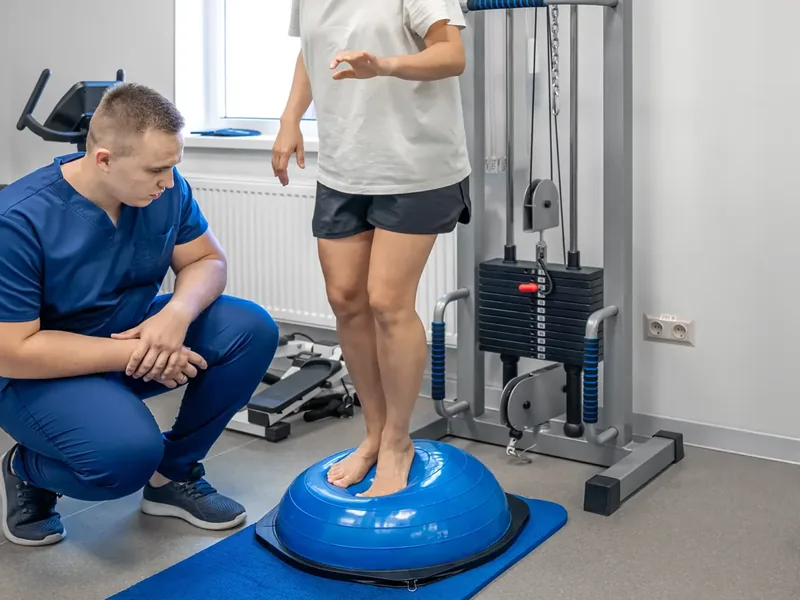
Gait work on posture, stride length and cadence, with rhythmic cueing, and balance retraining on surfaces that get less forgiving as you get steadier.
Phase Four
Prevent
The rugs and the thresholds at home, the footwear, the right cane, walker or orthotic if you need one, and a routine you can run yourself. That’s the endpoint, not another appointment.
Questions, Answered
You don’t have to. California’s Direct Access law lets you start with a licensed physical therapist for up to 45 days or 12 visits, whichever comes first, before a physician has to sign off. If the evaluation points at something medical, a medication side effect, an inner ear problem, a new neurological change, we’ll tell you and coordinate with your doctor. Starting here doesn’t replace your physician. It gets the movement work going now instead of after the next appointment.
That fear is the reason to do this with somebody, not a reason to skip it. Every visit is one-on-one with a licensed physical therapist, right next to support you can grab, and it starts at a level you can already handle. It gets harder only once you’ve earned it. The point isn’t to find out whether you’ll fall. It’s to build the strength and reactions that keep you up.
You get a plan with an endpoint, so you always know which phase you’re in and what’s left. As a general guideline, not a guarantee, 2–3 visits a week for 4–6 weeks is what gets the most out of a plan. Medicare is accepted here, and under the 2013 Jimmo Settlement Agreement it must cover skilled therapy that maintains your condition or slows decline, not only therapy that improves it. That matters when the underlying cause is a progressive one. We accept 14 plans in total and check your benefits before you start.
Book Your Visit
Request a time and a real person calls you back during business hours. No phone tree. No ‘someone will reach out.’ Just a plan.
We call back during business hours, Monday to Friday
Step 1 of 5
That’s the hard part done. We’ll call during business hours to lock in your time.
Visit Us