
From visit one
Pain
Take the edge off.
Hands-on work settles tight, guarded muscle and nerve-related pain, so the harder work is something you can actually tolerate.
What We Treat
A diagnosis changed what’s on the chart. What changed at home is the hallway, the stairs, and standing up without a hand. That is exactly what therapy works on.
Sound Familiar?
Two or more, for you or for someone you look after? Keep reading.
Why It Happens
Movement starts as a signal. Brain, to spinal cord, to nerve, to muscle, thousands of times a day, without you ever thinking about it. A stroke, a brain injury, MS, Parkinson’s or a damaged nerve interrupts that line. The muscle itself is often fine. The instruction reaching it is not. That is why the effects look so scattered: weakness down one side, a foot that catches, hands that fumble, balance that gives way, pain that follows a nerve.
The nervous system can also relearn, and that is the part most people are never told. Not from rest, and not from exercise in general. From practicing the exact movement you want back, correctly, often enough for the pathway to hold. So the first job is finding which part of the chain broke, which is what a cause-first evaluation is for. If you are reading this for someone else, you are already doing the hardest part. The next part is getting a straight answer about what can still change.
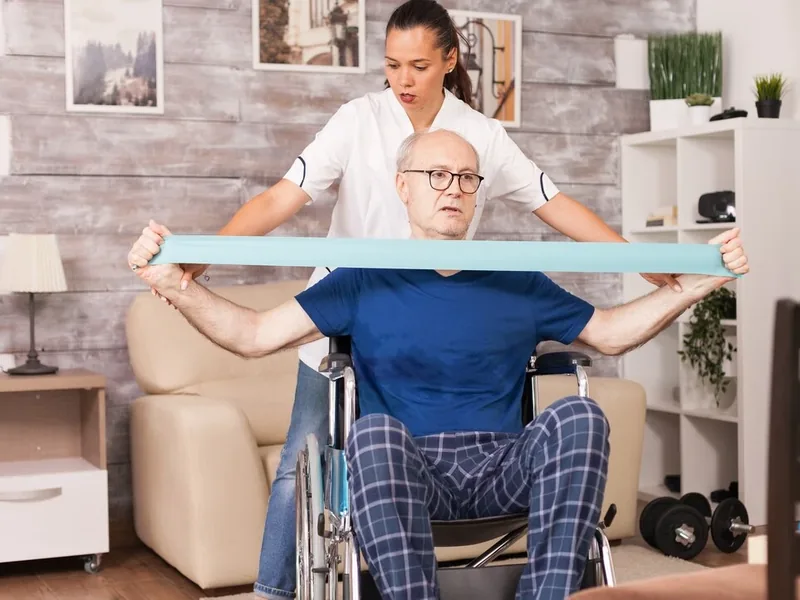
The Honest Truth
Nobody regrets starting too early. Plenty of people wish they hadn’t waited.
How We Fix It
Every phase has a job and a way to know you’ve earned the next one. Here’s what the four look like when the target is function you can use at home.
From visit one
Pain
Hands-on work settles tight, guarded muscle and nerve-related pain, so the harder work is something you can actually tolerate.
Early weeks
Prime
Motion, positioning and control come first: sitting steady, standing evenly, getting the weaker side back into the job.
The main block
Perform
Walking, stairs and transfers, trained as the task itself.
Ongoing
Prevent
With a progressive condition, Prevent means keeping function and slowing what you lose, carried forward by Fall Prevention and Functional Maintenance.
Questions, Answered
No. The nervous system keeps responding to practice long after the early phase is over. Earlier is better, and later is still worth doing. What changes is the goal. Sooner, we are often chasing a movement back. Later, we are chasing function, safety and independence with the movement you have. Either way, the first visit tells you which one you are working with, instead of leaving you to guess.
That is exactly what the supervision is for. You are one-on-one with a licensed physical therapist for the whole visit, so the work happens at the edge of what is safe, with hands ready. We would rather find that edge here than have you find it on the stairs at home. Family are welcome in the room, and we will show them how to help without taking over.
Two fair questions. On visits: a plan generally runs two to three visits a week for four to six weeks, then we reassess. That is a guideline, not a guarantee, and you will always know which phase you are in and what is left. On coverage: the Jimmo Settlement Agreement of 2013 obliges Medicare to cover skilled therapy that maintains a condition or slows decline. You do not have to be improving to qualify. Most families are never told that, and it is the basis of our Functional Maintenance program.
Book Your Visit
Request a time and a real person calls you back during business hours. No phone tree. No ‘someone will reach out.’ Just a plan.
We call back during business hours, Monday to Friday
Step 1 of 5
That’s the hard part done. We’ll call during business hours to lock in your time.
Visit Us